SUMMARY
In question were objects produced in red gold alloy with an 18ct count. These, after the entire production cycle, had no visible defects. Subsequently, after a period of 3-4 months, during the display in the store, stains began to appear on the surface that compromised the aesthetic quality of the objects.
PROBLEM
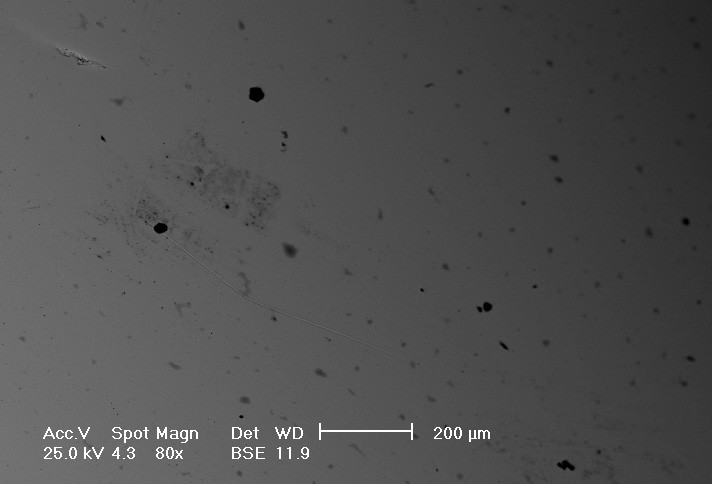
The problem was related to the presence of widespread microporosity on the surface, as can be clearly seen in the photo below:
Inside these small cavities, according to what was ascertained during our investigations, small quantities of acid were trapped which was used for the pickling and degreasing processes of the objects during the production cycle (we were faced with a phenomenon of slow corrosion). The two photos below show, respectively, the detail of a cavity with the stains that have formed on the outside and a chemical analysis of the inside of the cavity that confirms the presence of an unwanted chemical element (sulfur) which in our opinion derives from the type of acid used.
SOLUTION
There are two solutions:
- Worry about accurately analyzing the result of melting an object, making use of a stereoscope. The magnifications provided by this instrument would have been sufficient to detect such porosity on the surface and to prompt the operator to make changes in the process to ensure that the problem would be solved. In this way, the cavities would have been absent and therefore more difficult to retain acids used during the production cycle.
- If the size of the defect is not such as to justify such a thorough investigation under the stereoscope , it is necessary to proceed by trying to neutralize, as best as possible, the acid residues . Therefore, the final neutralization steps should be carried out carefully and methodically and if necessary several times. In this specific case, since it was 18ct red gold, it was a very delicate alloy susceptible to acid corrosion due to the high presence of copper.