SUMMARY
Recently, in the production of micro-cast objects, most centrifugal systems have been supplanted by static systems. However, those who still use the centrifugal system can run into a rather typical problem: the use of fluxes during casting in order to protect the metal can lead to flux inclusions in the alloy, carried by the metal inside the mold.
PROBLEM
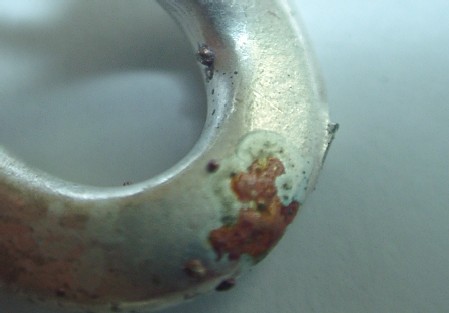
As you can see from the next figure, in the surface of the object we are examining there is a morphologically particular area.
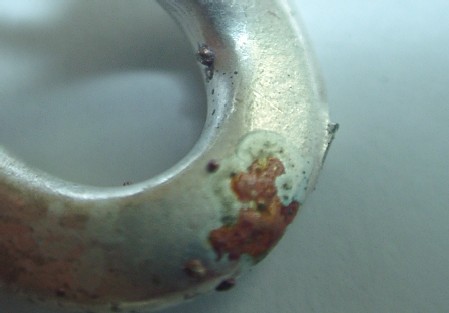
A centrifugal system was used to make this piece, with the use of boric acid in order to protect the molten metal from any oxidation. Evidently, however, the slag above the molten metal bath was not completely removed before the casting: a part of boric acid was in fact dragged by the metal at high speed inside the cylinder.
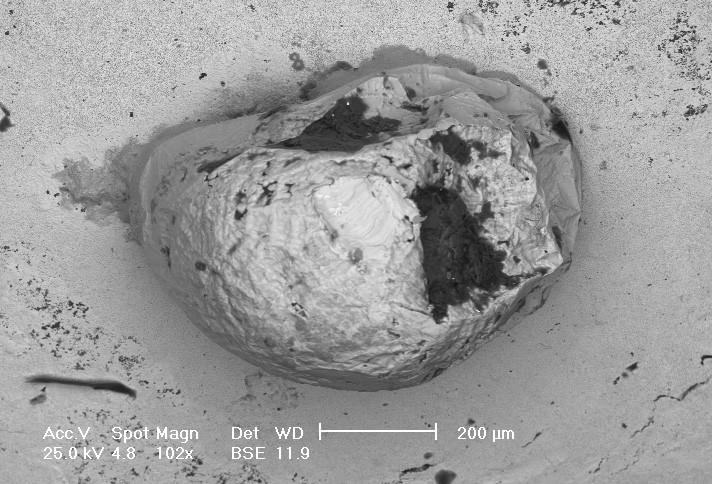
Boric acid is not always clearly visible, sometimes (as shown in figure 2) the defect emerges only later. For example, during heating and welding; In the example, the imperfection comes in the form of a bubble of boric acid embedded within the metal.
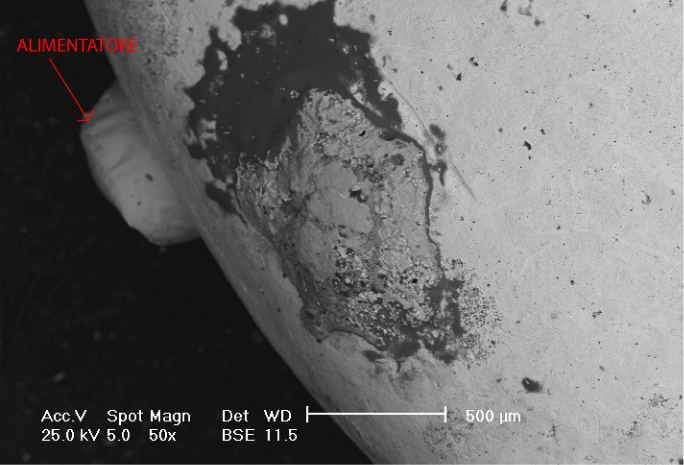
The next figure clearly illustrates a dark spot, positioned near the feeder area, composed of flux elements.
SOLUTION
To overcome this type of inconvenience, it is suggested to:
- Try to use as much flux as possible with a rather high melting temperature and with a high viscosity in the molten state, in order to make its removal much easier.
- Complete removal of boric acid is very important; Another expedient that can be implemented to remove it completely, is to add, during slagging, more cold boric acid, in order to increase its viscosity and make it agglomerate into a single entity that is easier to eliminate.
- Avoid fluxes such as borax.
- In the case of using a centrifugal system, it is preferable to melt in a controlled atmosphere. Otherwise, a mixture of nitrogen and hydrogen (in proportions of 95-5) can be blown onto the surface of the metal, which has a function similar to that of boric acid and allows you to operate in a cleaner system.