SUMMARY
With the hand casting technique it is very common to have this type of defect. The starting section of the ingot and the percentage of cold working are essential for the quality and compactness of the printed object.
PROBLEM
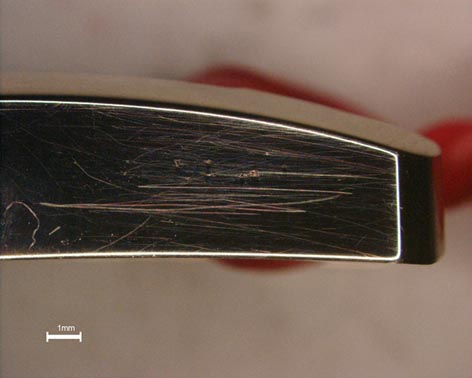
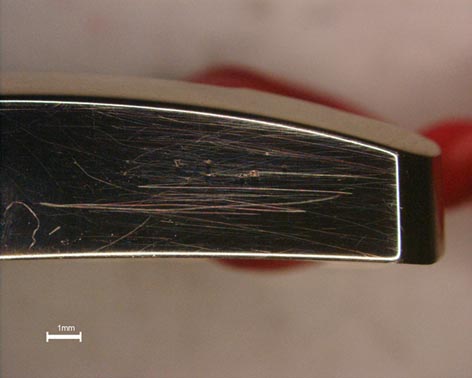
This problem mainly depends on the casting technique in the stirrup and the cold processing of the ingot. By manually pouring the molten alloy inside a bracket, it is normal for blowouts and defects to form on the surface and inside the ingot. In order to have a good compactness of the alloy and the complete elimination of these defects, rolling becomes an important phase. In the first photo you can see some defects that are present on a watch case; in this case it is a 14ct white gold alloy. The thickness of the plate before molding was 6mm, and the thickness of the ingot after casting was 10mm. The reduction in section, 40% in this case, was insufficient to ensure the complete elimination of the defects generated during the casting of the alloy.
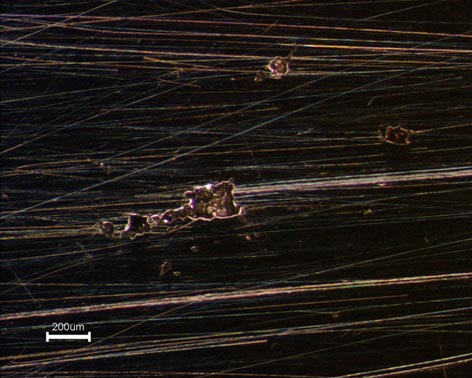
The second picture shows the defect magnified by stereoscope; it is very easy to see that these are blowouts formed during casting (they are clean cavities inside and therefore they are not inclusions). The reduced lamination was unable to close them and for this reason during the final cleaning phase these irregularities of the surface were evident.
SOLUTION
The solutions to this type of problem are as follows:
- Carry out more extreme cold working. 70-80% should be achieved to ensure good compactness. The initial thickness of the ingot, in this case, should have been at least 20-25mm (3-4 times the final thickness)
- Pour the alloy not too quickly trying to avoid a turbulent regime during filling as much as possible