SUMMARY
Fire stain is a classic defect affecting silver alloys produced by investment casting, in particular when the flask is exposed in the air for a prolonged amount of time, such as for example in the case of casting items with stones in place.
PROBLEM
In the case at issue, some 925 silver pieces of jewelry produced by investment casting with pre-set stones displayed some evident stains on their surface after polishing. An accurate analysis carried out on the production cycle of the samples outlined that the only "abnormal" element was cooling: in fact, the flasks were slowly cooled in the air after investment casting, for preserving the stones from breaking phenomena.
Therefore we hypothesized that it could be a matter of fire stain, classic defect affecting silver alloys produced by investment casting, in particular when the flask is exposed in the air for a prolonged amount of time, like in the case at issue. This kind of defect usually appears in the form of dark surface stains; at higher magnification, it can be noticed that these stains are made by gatherings of small dark spots mainly composed by copper and oxygen (copper oxides). The defect is very difficult to eliminate by polishing, as often it affects not only the pieces' surfaces but also whole sections.
In the case examined, the flasks remained into contact with the air for about one hour before being quenched. This created particularly favorable conditions for the development of the fire stain phenomenon. For this reason, to solve the problem, the type of flasks cooling was modified.
SOLUTION
To solve this kind of problem it is suggested to pay close attention to the treatment of flasks before their quenching. On that point, it is suggested to try to cool them in the following way:
- Just after casting leave them inside the casting machine for the longer possible time;
- Take the flasks out and leave them cool in the air for about ten minutes;
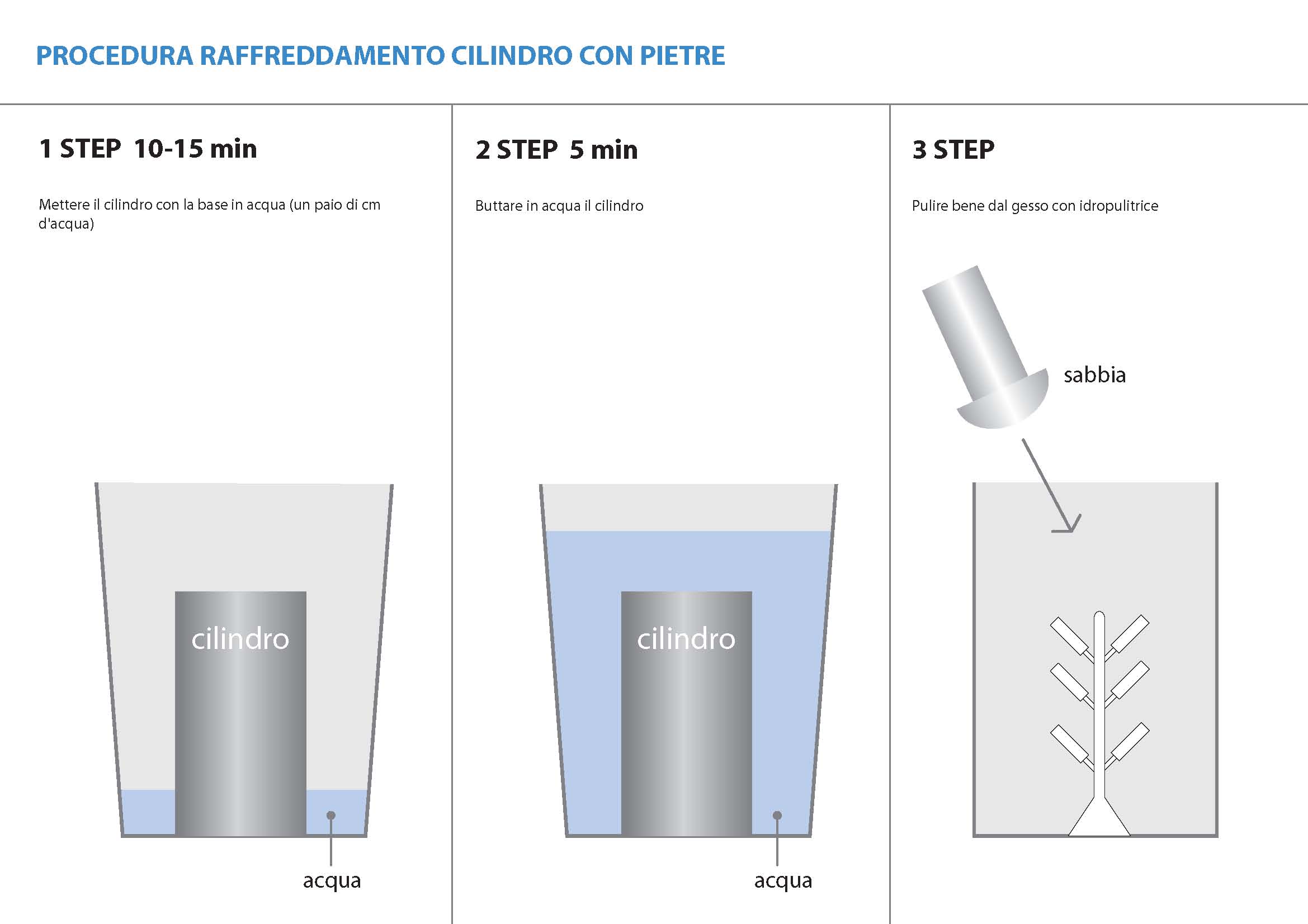
- Put them in a tank filled by 3-4 cm of water for about a quarter of hour;
- Finally, quench the flasks in water.
- This proceeding is summarized in following Figure.