SUMMARY
Gas porosity is influenced by both the quality and storage of the investment, but also by the burnout cycle. If the cycle is not carried out in a proper way, the investment does not obtain its highest features of mechanical resistance and then it will not be able to avoid the reaction with the molten metal during casting.
PROBLEM
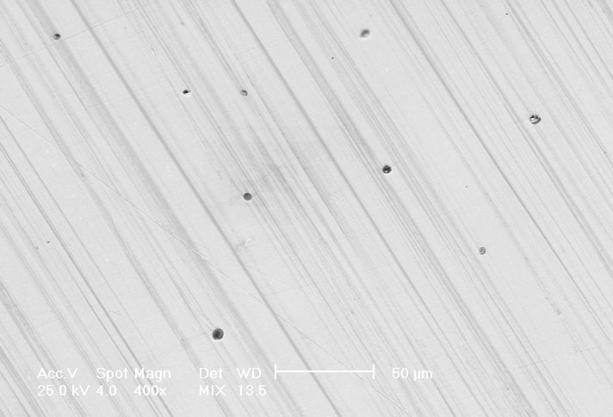
In the case at issue, some 18 ct yellow gold items produced by investment casting are affected by several porosities. These defects are well spread all over the surfaces of the samples and, at high magnifications, they look like round and rather regular cavities, sized about 5 µm.
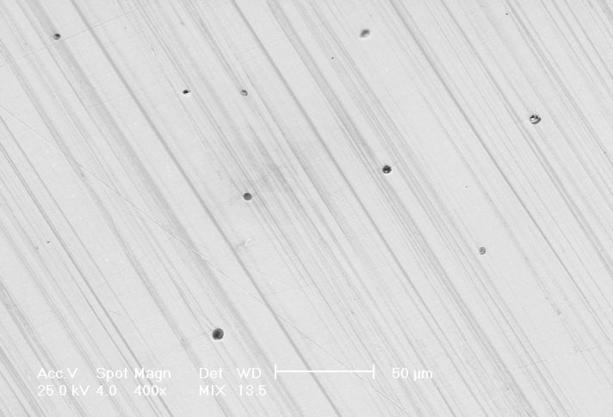
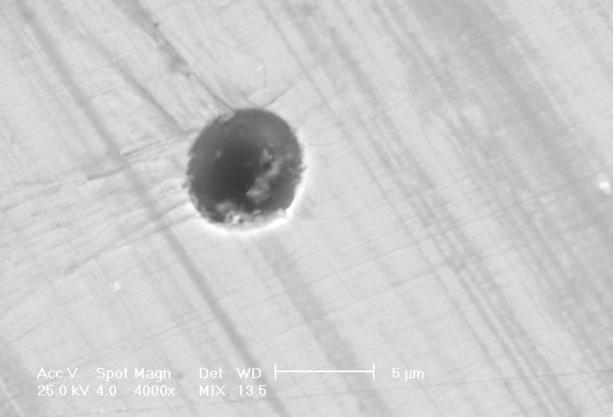
The defects outlined under the electron microscope have the typical morphology and diffusion on the items of gas porosity. This kind of defect is caused by a chemical reaction that occurs, at high temperatures, between metal and investment and it involves the formation and release of gas. Gas is then included into the items' surfaces in the shape of rounded porosities. These defects are hardly removable by polishing, as usually they affect also a certain thickness of the material. In addition, by means of an action of the abrasive during polishing, the comet effect may take shape (and in that case it can be observed at low magnifications as well), as the abrasive particles tend to get trapped into the pores.
SOLUTION
To solve this kind of problem, it is important to try and reduce as much as possible the reaction between the molten metal and the investment. For this reason, after checking the quality of the investment, it is important to try and optimize the flasks burnout cycle, strictly following what suggested by the investment's producer.
An example of standard cycle used in ProGold is reported below. It lasts at least 15 hours and it can be applied to a medium-sized furnace (8-10 medium-sized flasks) with wax-drainer:
- after preparing the investment, leave the flasks rest at room temperature for at least 1 hour, then put them inside the chamber of the furnace (that should be at room temperature);
- from room temperature 1 hour at 200°C with open pipe;
- 4 hours of permanence at 200°C with open pipe;
- from 200°C 2.5 hours to reach 400°C with closed pipe;
- from 400°C 2.5 hours to reach 750°C with open pipe;
- 4 hours of permanence at 750°C with open pipe;
- from 750°C 1 hour to reach the required temperature for casting.
It is fundamental that the cycle lasts at least 14-15 hours and in any case the time reported on the technical datasheet of the investment.
We'd like to emphasize that a proper burnout cycle is fundamental, as it allows the investment to reach its highest features of mechanical resistance and then react with metal in a notably limited way.
In addition, in many cases to limit the metal-investment reaction it is recommendable to check if it is possible to reduce the flasks temperature (possible rise of form filling problems permitting).