SUMMARY
In case of casting in open systems (i.e. casting by torch), the more or less oxidative conditions of the flame can influence the final composition of the material. The condition of oxidative or reducing flame can involve the possible reaction of given elements with the Oxygen present in the air (for example Zinc). Such elements, being also responsible for the material’s colour shades, can cause some fundamental differences of superficial colour, in case they were in concentrations different from foreseen.
PROBLEM
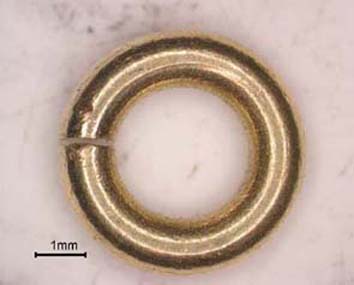
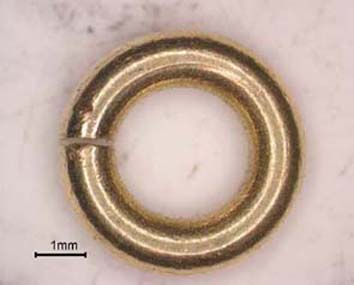
The problem appears as a colour change on items produced following a standard cycle (that is repeatable), after a welding-by-torch phase under a non-protected atmosphere. Afterwards, the piece was quenched and then rolled. Semi-finished products created in this way showed a different colour than those coming from vacuum castings. The colour is brighter (see the first photo) and at first glance they are more yellowish and then lighter. We also found out the problem was more evident during polishing phase. This very last factor made us think it was not a matter of a normal oxidation, as the colour persisted also during following working phases.
SOLUTION
The first assumption was leaving the hypothesis for this colour variation was a matter of Zinc's evaporation phenomena, as the piece should be more reddish and not more yellowish. Besides, the results of chemical analysis carried out by an external laboratory showed that the global composition of the samples with an altered colour could be considered identical to the one of regular samples. In fact, the outlined differences can not justify colour perceived as different by the human eye.
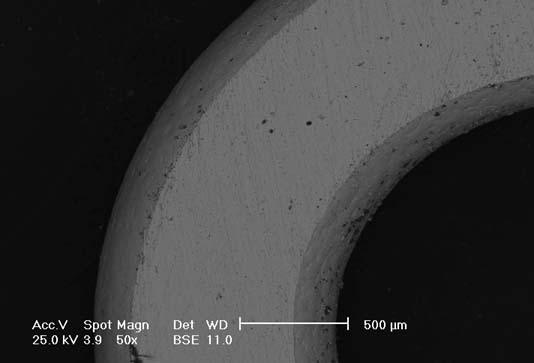
A superficial microanalysis, carried out both on samples with altered colour and on regular samples, showed that the light yellow coloured sample's surface (altered sample) had a very high content of Gold and Silver, while it had low values of Zinc and, above all, Copper, rather than the surface of the standard sample. In our opinion, this was enough to explain the outlined colour difference.
Here attached is a SEM microscopy of some analyzed surfaces.
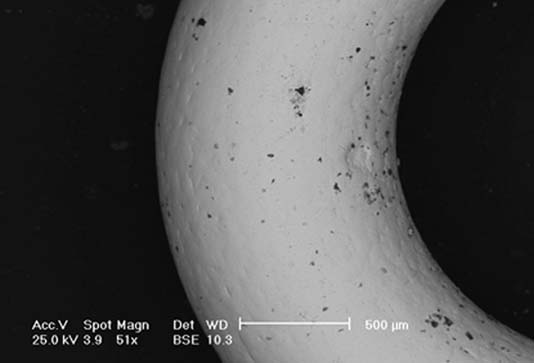
Different elements' contents, even if comparable with the values determined by the external analysis, are not the same, because different analysis techniques were used, An important consideration is that, even by microanalysis, the composition differences, found out on the surfaces of the two pieces of different colour, disappear when the altered sample is sand-papered (by removing a layer of around 100 um of thickness): the composition in sand-papered area is the same of the 3N colour item (and therefore, the colour is the same). See the next two photos.
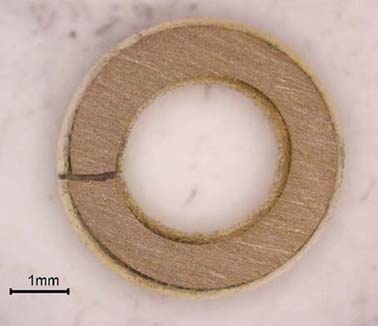
It is our belief that the colour change does not depend on evaporation, but on oxidation during welding torch melting phase: Oxygen tends to combine together with Copper and Zinc, which are the more electronegative elements, being Gold and Silver nobler. In addiction, the oxidation deepness was so that the oxidized layer was not removable by polishing phase. In order to understand the phenomenon, you can think about "doing the whitening" (when an item is deoxidized by acid pickling): on the surface there is preferential decomposition of Copper and Zinc, and so they alloy remains rich in Gold and Silver; the result is a different composition in the superficial area only. We hypothesize such area could have a thickness around 50-60 um. From this consideration, you can understand the reason why the external laboratory did not find a substantial difference in composition of the two colours between the two samples with different colour. Anyway, it must be underlined how fundamental turns out to be controlling and checking the casting process' conditions (such as casting temperature, hydrogen-oxygen ratio, if borax or other protection systems are used during casting), the acids used for the whitening phase (concentration) and permanence time inside the acid itself.