SUMMARY
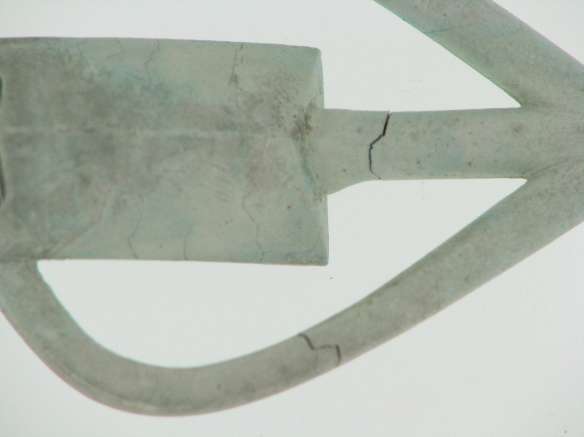
The phenomenon of hot embrittlement ("hot tearing") is typical in investment casting processes involving the use of silver alloys. In particular, this failure mechanism is also promoted by the presence of elements foreign to the original composition of the alloy. Excessive reuse of waste can therefore be particularly harmful not only from the point of view of the surface quality of the objects but also for obtaining intact and resistant products.
PROBLEM
The phenomenon of "hot-tearing" is linked to the formation of interdendritic or intergranular cracks, formed at temperatures higher than the solidus temperature of the alloy, thus occurring in the very first moments after casting. It is therefore a question of embrittlement not strictly linked to excessive thermal shocks. In fact, it is not possible to avoid it by changing the speed at which the cylinders are extinguished in the water. "Hot tearing" is caused by the stresses created following the shrinkage of the solidifying material that act on the part of the metal that is still interdendritic or intergranular liquid. Liquid parts have a mechanical resistance obviously lower than solid areas. The permanence of these liquid domains for a long time at temperatures close to the solidus temperature therefore increases the probability that the stresses will be able to crack the material.
Typically, the morphology of the fracture surfaces shows that at the time of rupture there was still the presence of liquid, with grains not yet fully formed.
In the case under examination, however, the microanalyses conducted on the fracture surfaces revealed the presence of elements not compatible with the starting alloy, in particular silicon, sulfur, and oxygen (see microanalysis 1).
These elements can increase the tendency for segregation of the alloying elements present, thereby leading to the breakage of the parts. The problem in question arose only following the reuse of scraps. The foreign elements are consistent with potential contamination due to the reuse of scraps originating from investment casting processes. The conclusion, therefore, is that the constant reuse of scraps, evidently not sufficiently cleaned, gradually increased the material's sensitivity to embrittlement at high temperatures, until the critical threshold was reached, after which fractures began to occur.
SOLUTION
To prevent the aforementioned issue, it is essential to pay particular attention to the reuse of scraps, and in particular:
- Never use scraps in percentages exceeding 50%
- Frequently refine the waste
- Thoroughly clean the scraps using acid or sandblasting
- Do not reuse the arbor core, due to the high density of oxides and impurities