SUMMARY
In this specific case study we examined some investment cast items made using 925 Silver, which displayed scratches on the surface, appeared right after the finishing step.
PROBLEM
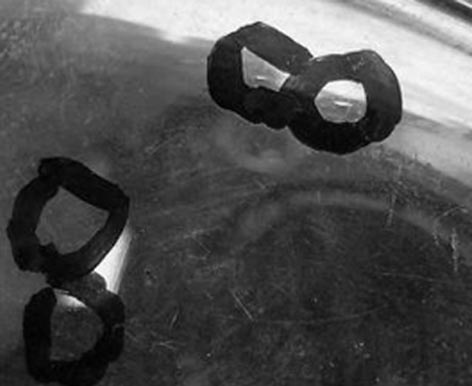
The problem faced was referring to the surface of the finished piece, which was very wide and scratched (see the first picture).
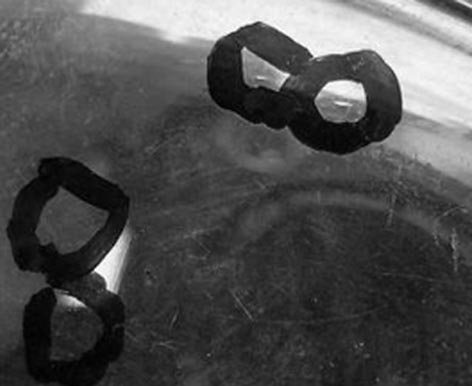
At-a-glance it seemed the defect was due to a metallurgic problem, i.e. some elements of the master alloy did not melt completely.
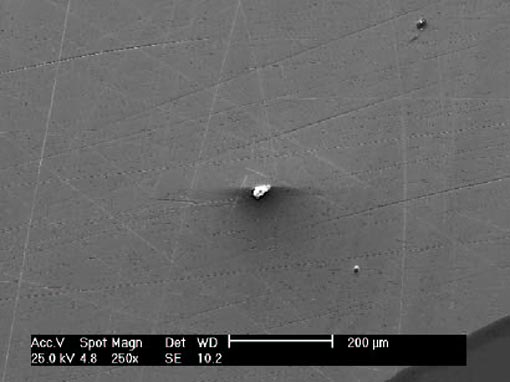
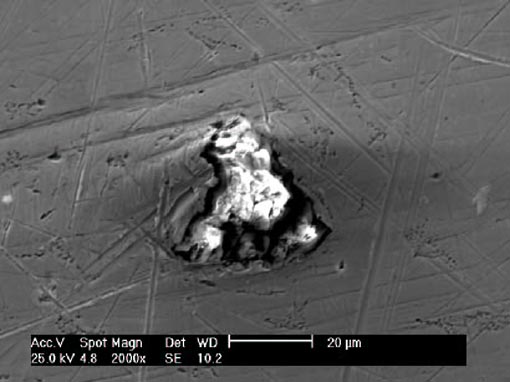
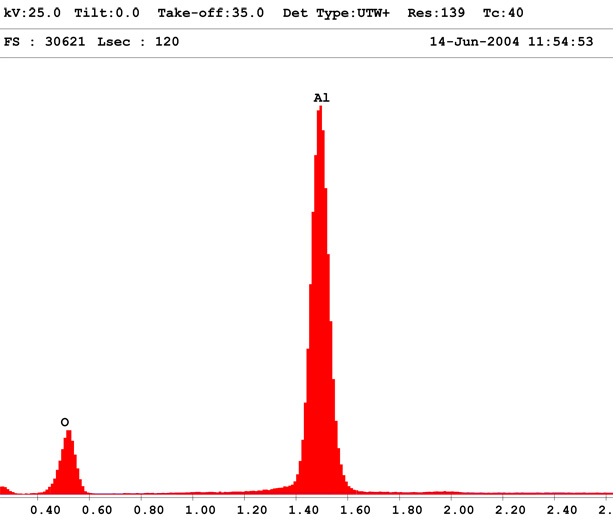
Carrying out a SEM analysis, the problem turned out to be caused by some residuals micro-particles of abrasive, which stuck into the surface of the pieces themselves. In the following micrographies it is outlined what observed, they appear to be very similar to hard spots (see picture2 and picutre3). By the results of the chemical analysis we also found out that their composition was made of Aluminium and Oxygen (see figure1).
Getting a little deeper into the matter and collecting some more information from the customer, regarding the finishing step, we realized they were using a vibratory barrel.
Once this very last one used to finish, some particles of abrasive contained in the drums were depositing on the piece itself, sticking onto it.
Further on, during the final polishing step with the bristle brushes of the hand finishing bench, a scratch remained on the surface of the pieces, this was stressed in the polishing direction, or better it was depending on the direction in which the piece was put under the bench itself.
SOLUTION
The solutions adoptable to solve this type of problem might be the following:
- Pay close attention while choosing the abrasives to be used in the vibrating barrels. Silver needs particular abrasives made of very tiny particles and not excessively hard. Moreover, the solutions should be adequate to reduce this sort of phenomena, nonetheless the cleaners should be chosen with very much care.
- These steps (barrelling) are carried out on a surface which, at the time, has a hardness of 50-60 HV. By taking into consideration the precious metal, silver in fact, it displays lower hardness values, as in the case study examined. It would be better and more convenient to increase the hardness of the pieces by carrying out a hardening heat treatment beforehand, reaching values of at least 100 HV. This device will for sure simplify the final polishing and finishing step, also increasing the surface quality of the finished piece.