SUMMARY
In fast wire casting processes to pay attention to the machine’s stop is fundamental, because in these periods of time the shrinkage phenomenon takes place. It is a physiological and unavoidable phenomenon that involves the formation of a cone in the last area that solidifies and it could cause apparently unexplainable breaking problems.
PROBLEM
In the case at issue, some breakings faced with a 14 ct red gold wire are examined. For its production, 8 Kg of material were cast in a fast wire machine. No particular problem was faced, but the machine was stopped two times. Afterwards, during polishing, the wire broke in two different areas.
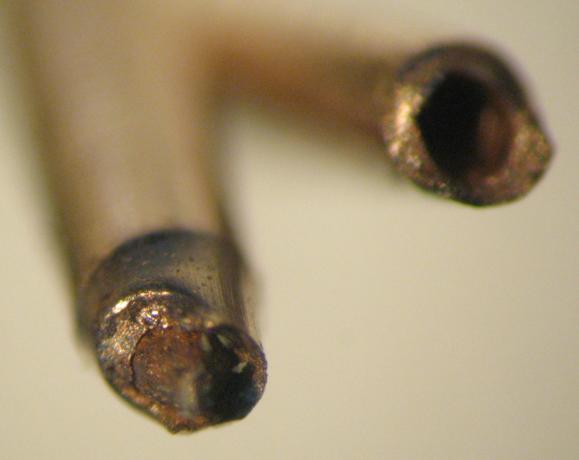
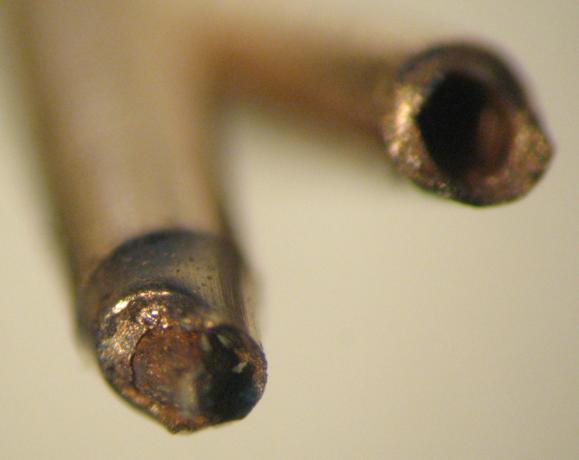
The fracture surface is empty and irregular, as you can see on Figure 1. An accurate analysis of the information at our disposal and a study on the morphology of the fracture surface lead to the conclusion that the problem at issue is imputable to the machine's stop periods of time, that is when the daily job ends or, for example, when the machine is stopped to charge the crucible with some further material.
It is a common problem in fast wire machines (in particular when wires with small section have to be realized), that rises due to the fact that as soon as the machine is stopped the metal starts to solidify inside the die. During solidification, the final part of the metal tends to form a shrinkage cavity inside the die. Here a «weak area» forms, that may provoke breaking problems during following working steps. In fact, if this cavity is not eliminated before the start-up of a new working cycle, during following deformation workings it may cause some problems like those shown on the picture.
The presence of a shrinkage cone inside a wire entails a reduction of the resistant section and it may involve the breaking even with reduced charges applied. In particular, during rolling and drawing the cone is lengthened and then the defect will be present in an extended area of the material, provoking an increase of the possibility of experiencing breaking problems.
SOLUTION
To limit this kind of problem, it is necessary to make sure to eliminate the shrinkage cavity from the center of the wire. To make this there are two paths to follow:
- If you have the possibility, after the machine's stop you can try to come back with the drawing, recasting the part of alloy that contained the shrinkage cone, so to eliminate it.
- In alternative, when you pull the wire out after the machine's stop mark with a felt tip the last solidification zone of the metal inside the die (as above explained, that containing the shrinkage cavity); afterwards, cut a portion of material of some centimeters (divided between the parts above and below the previously made mark), so to remove even in this case the cavity causing the described problems.