SUMMARY
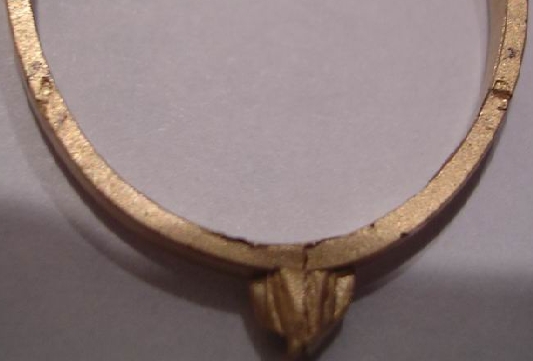
In this specific case, we considered a 14ct red gold cast ring, which displayed some superficial defects. These defects, if wrongly and hasty evaluated, might have been evaluated as casting defects. Such “look-like” holes were actually collocated in different areas of the finished piece. Its main feature is that, despite in the case taken into consideration we were dealing with read gold alloys, if the same piece were cast with another alloy, the chance to face the same defect was absolute.
PROBLEM
The problem was involving some cavities present on the surface of the piece of generically regular, rounded and stretched shape. They looked like as being very clean, smooth and delineated in their insides, even after a simple observation at naked eye and without the help of any instrument.
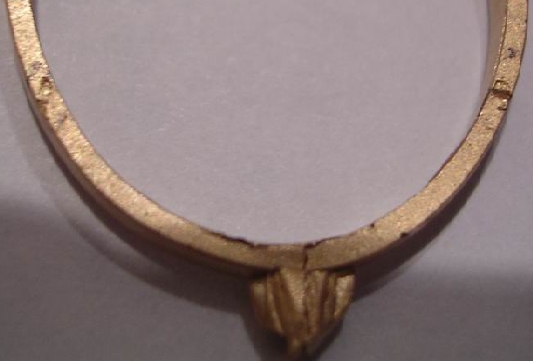
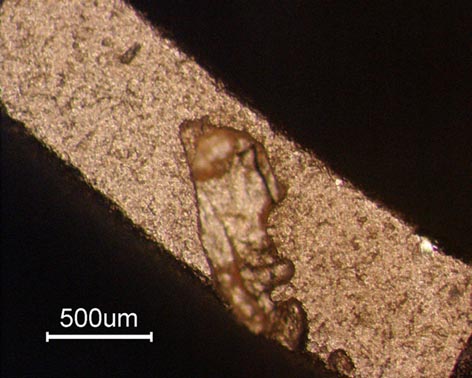
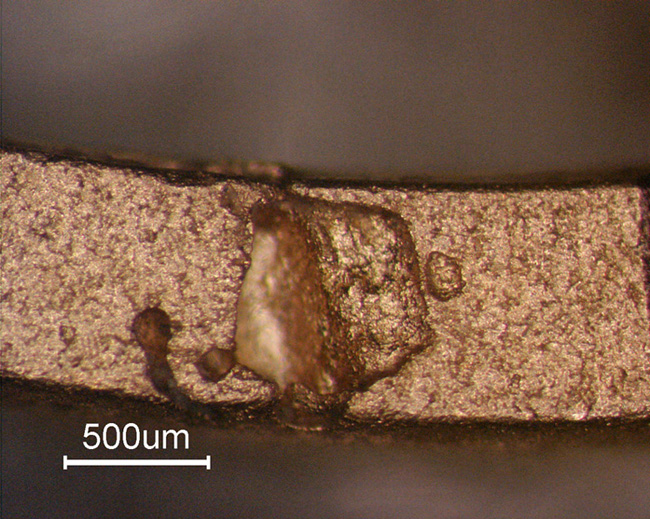
As you can easily notice by the pictures reported above, the cavities turn out to be less contaminated and clean even after several magnifications.
It is not, in spite of why might be thought, a defect connected to the metal itself, but a bulge of investment, which cavity, further on, takes the form.
Such cavity comes for sure from the fact that the waxes themselves already contained at their inside some air sacs. During the filling of the flask with liquid investment and the further aspiration of the air bubbles created inside the investment, this standard operation created a depression originated by the vacuum made, which in turn, created a kind of force on the surfaces of the waxes, enough to break the very thin wax film wrapping the bubbles.
In fact, inside the wax a sac of air shapes, this is caused by its turbulent regime took during the rubber mould filling or for the reason that inside it there were some air bubbles entrapped. These spheres of air tend to place on the most external part of the wax element, i.e. in the closest area to the surface. The thickness between the outer of the wax and the bubble itself is slender; during the depression made with the vacuum, this even very thin film breaks and at that point the investment fills the sac.
When casting takes place then, the molten metal will occupy also the room created by the air bubble giving place to the defect examined.
SOLUTION
- Pay very close attention to degas the wax inside the injector.
- If the injector is creating the vacuum, you should carry out the vacuum in the casting chamber at least once a day or every time you fill it up with new wax.
- Leave the wax in depression to let the air bubbles entrapped in the liquid wax to reach the surface
- If you do not have a vacuum injector on your disposal, try and make some adequate empties in the rubber to let the air included go out once the wax is filling it